03
CACD 2009Discursiva
Resposta escrita, em até 60 linhas. Na Falcon, você escreve e recebe a correção com os critérios da banca.
Questão 3 do CACD 2009, Língua Inglesa. Questão discursiva. Resolva aqui: a correção vem na hora, com gabarito e comentário.
Enoch Powell had a point. The radical British Conservative politician warned, nearly four decades ago, that immigrants were causing such strife that “like the Roman, I seem to see the River Tiber foaming with much blood.” That proved to be nonsense, as did his advice that migrants should be encouraged to leave. Had they done so, Britain and other rich countries that depend heavily on foreign labour would be in a dreadful state. One prediction he made was spot on, however: that by about now, one in ten people in Britain would be migrants. At the last count in 2005, the foreign-born made up 9.7% of the British population.
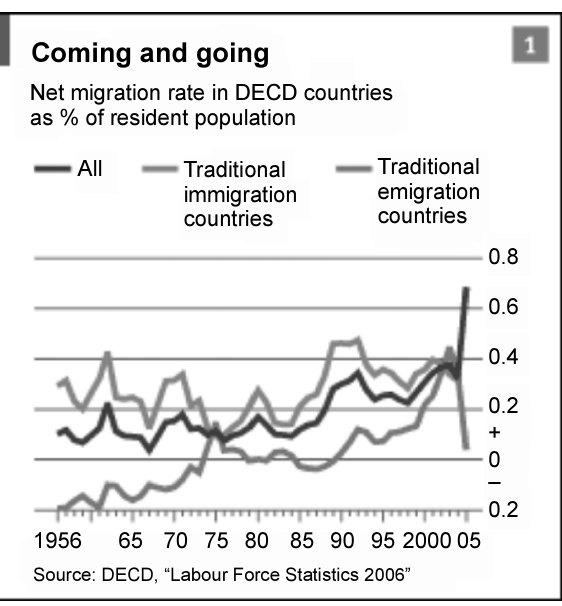
By historical standards, that is high but consistent with that in other rich economies. In America the proportion is now about 13%, not far off the 15% peak reached shortly before World War I. What is particularly striking in Europe is that countries which had hitherto known only emigration, e.g. Ireland or Greece, now have an influx typical of countries like Australia and the U.S.
This special report argues that both emigration and immigration countries, as well as the migrants themselves, have been coping remarkably well with this new force reshaping our world. Yet ominous signs are emerging of a shrill backlash against immigration on both sides of the Atlantic.
Politicians may tinker with migration policies. They will certainly, under public pressure, pump extra resources and energy into building more fences and walls to keep foreigners out. By linking immigration to terrorism, they may even make their societies more fiercely policed. The basic forces driving migration, though, are unlikely to ebb.
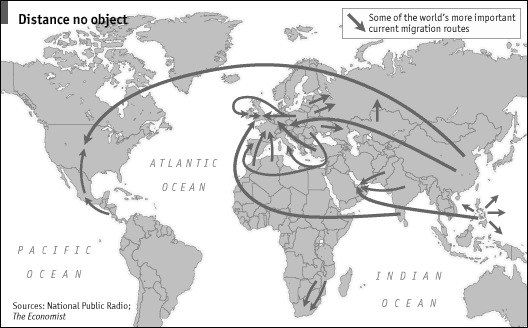
Migrants move mainly for economic reasons. Most appear to do so legally. The number of illegal migrants is by definition hard to ascertain, but likely to be smaller than the legal sort. They probably comprise the bulk of those seen floating on rafts in the Mediterranean or scrabbling over the fence from Mexico to America. Others do not risk the high seas or physical borders, entering instead under some other guise, perhaps as tourists, and then staying on.
Lastly, there are refugees and asylum-seekers, strictly defined as those escaping persecution but often including anybody forced to flee, for example from a war. According to the UN's refugee agency, at the close of 2006 some 10m people fell under this category.
The number of migrants worldwide has been reckoned at 200m. That sounds a lot, but actually adds up to only 3% of the world's population, so there is ample potential for growth. Migration has proved a successful ploy for the world's poor to improve their lot. Nor is it the very poorest who travel, for money is required to travel overseas.
In the 100 years to 1920, brighter prospects encouraged some 60m Europeans to uproot and move to the New World. A European crossing the Atlantic could expect to double his income. Today the incentives are even more enticing. Those moving from a poor country to a rich one can expect to see their income rise fivefold. As long as such differentials persist, the draw will continue.
Demography too plays a big part. Not every migrant is bound for America or Europe: two in every five head for another poor or middle-income destination. Those aiming for the richest parts of the world, however, do their inhabitants a favour. Without them, the greying and increasingly choosy populations across the rich world would already be on the decline. That is paramount for their fast-changing economies, which consistently demand either highly skilled workers or those willing to do unpleasant and tiring jobs.
One reason why much of the world has enjoyed a sustained economic boom with low inflation in the past decade is that the effective global workforce is expanding apace. The IMF estimates it has quadrupled since 1980. In all likelihood it will continue to grow, though at a slower rate, with a 40% increase in the world's working-age population forecast by 2050. According to the UN, the global stock of migrants has more than doubled in four decades. Not enough young natives have the skills or motivation, so the rich must hope outsiders will keep coming.
And they will. Luckily for Europe and America, there are huge pools of workers eager to jump on the next plane, train or leaking raft to work abroad. This can prove beneficial for their countries of origin as well.
If exporting brawn generally makes sense for a poor country, letting its better brains drain away may not. Most poor and middle-income countries grapple with chronic shortages of skilled labour. Professionals in demand abroad are the hardest to keep at home. In fact, if the lure is strong enough, it is virtually impossible to block the exit of the highly skilled.
Rich countries are taking in more highly skilled migrants than ever before. Yet emigration of skilled workers may be a consequence rather than a cause of problems in the sending country. For example, nurses may be emigrating because their salaries are not being paid or because hospitals are crumbling; entrepreneurs may be relocating because the local business climate is wretched. Halting emigration - even if that were feasible - would not solve these problems. Nurses might still quit their jobs, would-be entrepreneurs might sit on their hands.
Indeed, some argue that emigration can actually enhance the stock of brainpower. Migrants spend longer studying, pick up more skills and experience, and may then return home. Remittances are often used to fund schooling. Moreover, the prospect of emigration and prosperity abroad may induce others to get an education. All this suggests that the consequences of emigration, albeit not negligible, are tricky to measure. Governments should thus endeavour to tackle the factors pushing their skilled professionals out. If émigrés can be enticed back home, even for short spells, so much the better.
Unfettered movement of capital and goods has made the world a far richer place while greater human mobility has not only created wealth but also helped share it out more evenly. The billions in remittances repatriated each year eloquently testify to that. The cost of keeping people out would be steep.
Nasty surprises are constantly sprung on us. Wars can suddenly displace millions, who may start out as refugees but frequently end up as migrants. Some claim that climate change may forcibly relocate tens of millions of people in the space of decades. Misguided policies, a backlash over terrorism or a failure to integrate migrants could all pose serious problems. Nonetheless, 40 years on, it seems clear that Mr Powell was utterly amiss in everything save his sums.
Summary
Write a summary in your own words not over 200 words in length of the following excerpt adapted from “Open up,” an Economist special report on migration published 3rd January 2008.
Como visitante, você corrige 3 questões por dia aqui mesmo. Com a conta gratuita, 10 por dia, com o comentário do professor e o seu desempenho guardado. Com o curso, o Banco inteiro.
A classificação é da Falcon: cada chip leva às questões do mesmo tópico.
Mesma matéria e mesmos tópicos do edital.
Enunciado e itens reproduzidos da prova pública do concurso, para estudo. Todas as questões de Língua Inglesa · Questões por matéria.